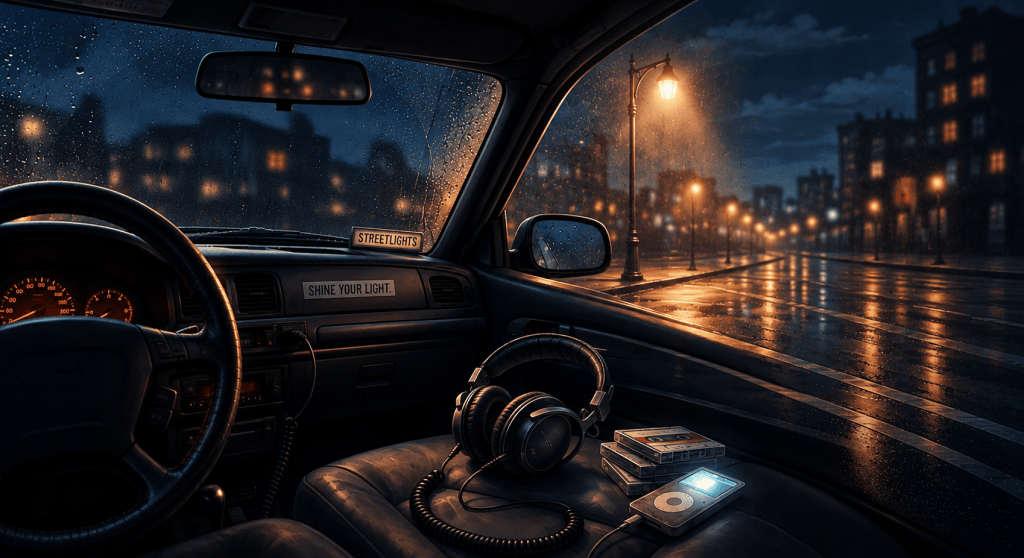
In case you want to listen to the songs that go with the story. ⬇️
When I was a boy, I had the good fortune of being exposed to a very diverse and eclectic variety of music.
I remember being as young as eight, in my PJs, lying on the shag carpet in our living room behind my dad’s mahogany bar. He had a turntable and receiver in the bar cabinet where I would plug in with these giant headphones and spend hours playing my mom and dad’s records.

I was introduced to artists like Crosby, Stills, Nash, & Young, Joni Mitchell, America, Joan Baez, and Bob Dylan. I found Chicago, Eric Clapton, and The Beatles, of course.
My dad’s parents lived in OKC. Whenever we would visit, especially on the weekend, I can remember my grandfather playing hymnals on the piano—there was always a little singing as well.
My mom’s mom was a music teacher in Lawton, OK. She had music boxes all over the house. There was a Grand Piano in her living room and all the surfaces in the room had some form of music collectible, like the hand-sized wooden puzzle that had the image and name of Mozart. Many items were breakable. My grandmother’s house could be considered a music museum; there were lots of DO NOT TOUCH verbal warnings. It would have been easier to put up red stansion ropes. She did let me go around the house winding all the music boxes and playing them. There were many.
I like Moonlight or Light of the Moon better too, Claude.
She force-fed me (at times) the classics. She started me out on Vivaldi, Tchaikovsky, and Mozart and had me familiar with Brahms, Beethoven, Bach, and Chopin before I ever took my first viola lesson. Begrudgingly, because she could really be cruel, I must also give her credit for introducing me to one of my favorite musical compositions of all time: the third movement of a piano suite called Suite bergamasque. That movement is “Clair de lune” by Claude Debussy. As I understand it, Debussy originally called that piece “Promenade sentimentale,” translated meaning Sentimental Stroll. I like Moonlight or Light of the Moon better too, Claude.
But my musical education didn’t stop with the classics or my family’s record collection. Between my mother’s friends, whom I spent a lot of time with, and my own friends, I learned all about Rock, Motown, the Blues, and—yes, as a true Gen Xer—all things ’80s.
My friends had passionate opinions and feelings about their favorite bands. To have a conversation with my friend Andrea, whom I met in seventh-grade orchestra, you absolutely needed a well-informed opinion and strong talking points about Duran Duran. My best friend, Rusty is probably the biggest authority on all New Wave groups. He introduced me to the English Beat and Depeche Mode anong many others. The first “girlfriend’ I had in Jr. High introduced to to “You Light Up My Life” by Debbie Boone. Carolyn played that song in the background when we talked on the phone. It was her theme. I don’t think I measured up to her mantra. She dumped me after two months, but in Jr. High, that was what we called a long-term relationship.
In my mind, the original recording of an iconic song was the definitive truth.
That’s the thing about music—it’s a living, breathing map of where we’ve been and who we shared the room with. But for a long time, my map had very rigid borders. Growing up surrounded by absolute masterpieces, I became a strict musical purist. In my mind, the original recording of an iconic song was the definitive truth. I stubbornly refused to give an ounce of credit or preference to covers, especially when it came to the most popular, untouchable tracks. To me, a cover was just a cheap imitation, a distortion of perfection. I locked those songs in stone, convinced there was only one “right” way for them to exist.
It took me years to realize that my stubborn purism wasn’t just limiting the playlists on my iPod; it was mirroring the way I looked at the world.
When we lock our perspectives down, we do the exact same thing to the people around us. We look at a stranger, a neighbor, or even a friend, and overlay them with our own rigid assumptions and psychological projections. We decide who they are, what their story is, and how they are “supposed” to sound before we ever truly listen to them.
…bound together by the same fundamental human chords, yet wonderfully enriched by the different ways we play them.
But when I finally allowed myself to open up to a great cover song, everything shifted. I realized that a new artist wasn’t destroying the original; they were bringing their own unique lived experience to the notes, revealing a hidden depth to the lyrics I had completely missed.
That is the beauty of our shared human diversity. Just like a brilliant cover song can take a familiar melody and give it a whole new soul, the diverse perspectives of the people around us give color and depth to our own lives. When we strip away our personal projections and actively choose to see people for who they really are, we stop seeing cheap imitations of our expectations. Instead, we see how deeply connected we truly are, bound together by the same fundamental human chords, yet wonderfully enriched by the different ways we play them.
Which brings me to the core of this week’s “Cover Me” project…
Track 1: “Heroes” (Covered by Peter Gabriel)
When David Bowie released “Heroes” in 1977, it was a soaring, triumphant anthem of defiance. It was a wall of sound that made you feel like you could punch through brick walls just by the sheer force of love and human will. It’s an iconic masterpiece.
But when Peter Gabriel stripped away the driving guitars and the rock-and-roll bravado for his 2010 cover, he uncovered an entirely different soul within the song.
Gabriel’s version is draped in dark, swelling strings. It doesn’t sound like a victory lap; it sounds like a dispatch from the trenches. It strikes a much deeper, darker tone that resonates in a completely different corner of the human heart.
For me, this version has earned a hallowed place on the StreetLights soundtrack because it captures the quiet reality of a battle so many of us know all too well: the lonely, exhausting fight against depression.
Depression thrives in the shadows. It tells you that you are isolated, that the darkness is absolute, and that your struggle is invisible. Gabriel’s heavy, melancholic arrangement emotes the exact texture of that midnight landscape. But as his vocals swell alongside those sweeping strings, the lyrics take on a profound new meaning.
It becomes a theme for how we can show up for one another. Being a hero doesn’t require a cape, a spotlight, or a grand gesture. Sometimes, being a hero just means sitting in the dark with a lonely warrior so they don’t have to fight the night alone. Through simple empathy, unvarnished love, and radical kindness, we can become anchors for each other on this sacred, difficult ground.
We can be heroes—even if it’s just for one day. Even if it’s just for the duration of a single song.
Track 2: “Save It for Later” (Covered by Eddie Vedder)
While The English Beat’s 1982 original track was a kinetic, ska-infused anthem of youth, Eddie Vedder’s cover transforms it into a profound retrospective. Hearing this song as an adolescent in the ’80s, it perfectly mirrored the chaotic confusion, burning angst, and overwhelming hormones of being young and figuring out where you fit. It was a double-entendre for both a frantic plea to “save it for later” because the present moment felt too heavy to process and a dismissal of input or advice coming from older, well-meaning people who try to help but don’t have the answers themselves.
Decades later, Vedder revisits the track not from the trenches of youth, but from the vantage point of survival. His weathered, experienced voice gives the lyrics an entirely new emotional gravity. It is no longer just a song about teenage friction; it is a direct conversation between who my generation was then and who we are now.
Looking back through a lens of deep nostalgia, Vedder’s performance honors those raw, unbridled emotions of our past while grounding them in the quiet wisdom of the present. It’s a beautiful, musical reminder that we made it through the noise.
Track 3: “Under the Milky Way” (Covered by Peter Rayburn & Bebe Bettencourt)
“Under the Milky Way,” originally released by The Church in 1988, is a masterpiece that has been covered a hundred times over. To be completely honest, whenever a remake comes on, I usually skip it and move on. I’ve even listened to the original so many times that I occasionally skip it, too—always with a hint of guilt, because it truly is greatness.
But this version by Peter Rayburn and Bebe Bettencourt completely stopped me in my tracks. It reached right in and grabbed my soul.
Musically, it transported me straight back to the open plain under a star-filled sky, where the stars were the only source of light—the exact place I found myself the very first time I ever heard the original track.
But this cover doesn’t just trigger memory; it invites a peaceful reflection on everything that has happened since. It forces me to weigh the struggles and the scars of my life against a beautiful silver lining. Listening to Bebe sing, I am reminded that every single storm I have weathered was ultimately followed by the light of joy, of love, and a deep, overwhelming gratitude for simply being alive.
As the weekend winds down and the playlist plays out, I’m reminded of why I started this journey under the streetlights in the first place. Every passenger who ever sat in my back seat was their own unique song—a completely different perspective, a different melody, a different lived experience. We are all driving through the same darkness, but when we choose to drop our assumptions and truly listen to one another, we realize how connected we are.
As you travel the many roads of life, I hope to see you out there, under streetlights on a Saturday night.

Be love. Be kind. We are all connected.
Life is better with a soundtrack.
By the way, there is a Cat Stevens song on the Spotify playlist where he covers himself to celebrate the song turning 50. It did change my perspective.
Some covers don’t have to be that deep. Sometimes, the cover is just… better!

Christopher Carlson writes about inspiring stories from his Uber and Lyft driving days. He drove 3 years and completed over 6,200 trips. Christopher also writes about his own journey through depression, recovery, and the constant unexpected turns on life’s path. We are all connected!


Leave a Reply